What Are the Legal Implications of Using Rails, Postgres, and Tailwind?
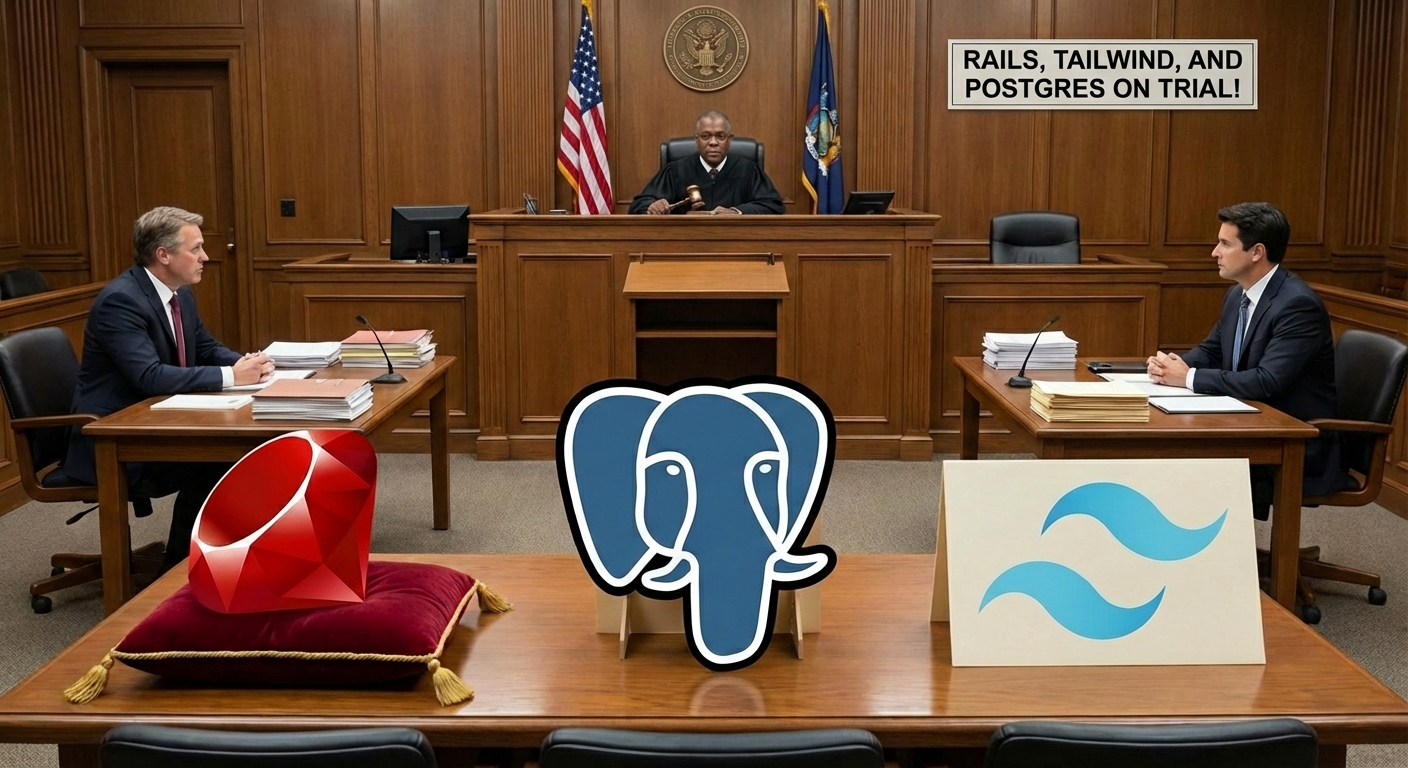
A potential client recently asked me a question: “Are we in the clear, legally, to build our entire business on Ruby on Rails, Tailwind CSS, and PostgreSQL?” The short answer is yes — emphatically. But the longer answer is worth writing down, because if you’re founding a company and choosing a tech stack, understanding the licensing landscape is just as important as understanding the technology itself.
This post breaks down why our favored technology stack (Ruby on Rails, Postgres, and Tailwind) is not only a strong technical choice, but one of the safest legal foundations you can build a startup on.
The Licenses at a Glance
Ruby on Rails is released under the MIT License. Tailwind CSS (the core framework, including v4) is also released under the MIT License. PostgreSQL is released under the PostgreSQL License, which is its own permissive open-source license that functions almost identically to the MIT and BSD licenses.
All three of these are permissive licenses. That word matters enormously. In the world of open-source licensing, “permissive” means you are granted broad rights to use, copy, modify, and distribute the software — including in commercial, proprietary, closed-source products — with very few strings attached.
What the MIT License Actually Lets You Do
The MIT License is one of the most widely used open-source licenses in the world, and its full text is only about 170 words. Here’s what it grants you permission to do: use the software, copy it, modify it, merge it into your own code, publish it, distribute it, sublicense it, and sell copies of it. That’s an extraordinarily broad grant of rights.
The only obligations it imposes are that you include the original copyright notice and the license text in any copies of the software you distribute, and that you accept the software is provided “as-is” with no warranty. That’s it. There is no requirement to open-source your own code, no requirement to share modifications, no requirement to pay royalties, and no restriction on commercial use.
This is the fundamental difference between permissive licenses like MIT and copyleft licenses like the GPL. Under the GPL, if you distribute software that incorporates GPL-licensed code, you are generally required to release your own source code under the same license. Under the MIT License, no such obligation exists. You can build a completely proprietary, closed-source SaaS application on top of Rails and Tailwind, charge whatever you want for it, and never share a single line of your own code.
PostgreSQL’s License: Equally Permissive
PostgreSQL doesn’t use the MIT License, but its own PostgreSQL License is functionally equivalent. It explicitly grants permission to use, copy, modify, and distribute the software “for any purpose, without fee, and without a written agreement.” The only requirement is that you retain the copyright notice and liability disclaimers.
There are no per-seat fees, no per-server fees, no limits on the number of databases, connections, or rows. There is no “community edition vs. enterprise edition” licensing trap — everything PostgreSQL offers is available under the same permissive license. Companies like Instagram, Spotify, and Apple use PostgreSQL in production at massive scale under exactly these terms.
What This Means for Your Startup in Practice
When you build on Rails, Tailwind, and Postgres, here’s what your legal obligations actually look like: somewhere in your application — typically in a licenses file, a legal notices section, or your documentation — you include the copyright notices and license texts for these projects. That’s the entirety of your compliance burden. Your legal team (or your future legal team, when you have one) will spend approximately zero hours worrying about this stack from a licensing perspective.
Compare this with the licensing complexity you might encounter with other technology choices. Some databases have dual-licensing models where the open-source version is GPL-licensed (meaning you may need to open-source your own code if you distribute it) while the commercial version requires paid licensing. Some frameworks use licenses that include patent clauses or contributor license agreements that require more careful legal review. Some tools have recently shifted from permissive to restrictive licenses specifically to prevent cloud providers and SaaS companies from using them commercially — the so-called “source available” licenses like SSPL and BSL.
With Rails, Tailwind, and Postgres, you sidestep all of that entirely. The licenses are short, well-understood, battle-tested in court and in practice, and impose no meaningful restrictions on building and selling software.
The Technical Case Reinforces the Legal Case
The legal clarity of this stack isn’t the only reason to choose it — but it reinforces a technical choice that already stands on its own.
Ruby on Rails has been powering production applications for two decades. Basecamp, Shopify, GitHub, Airbnb, and countless other companies built their products on Rails. The framework’s conventions around database migrations, routing, background jobs, and testing mean that you can move fast without accumulating the kind of architectural debt that slows teams down. Rails 8 in particular has leaned hard into simplicity — built-in support for Solid Queue, Solid Cache, and Solid Cable means you can defer the complexity of Redis and separate job processing infrastructure until you actually need it.
Tailwind CSS v4 represents a major evolution of the framework, with a new engine built on Rust that dramatically improves build performance. For a startup, Tailwind’s utility-first approach means your frontend team (or your solo-founder self) can build polished, responsive interfaces without maintaining sprawling CSS files or fighting specificity wars. The ecosystem of headless UI components and community libraries means you’re never starting from scratch.
PostgreSQL is arguably the most capable open-source relational database available today. It handles JSONB for semi-structured data, full-text search, geospatial queries via PostGIS, and vector similarity search via pgvector — meaning you can often avoid adding separate infrastructure for search, document storage, or AI/ML features. For a startup, consolidating these capabilities in a single database that costs nothing to license is a significant advantage.
The Bottom Line
These tools are released under some of the most permissive, well-understood, and commercially friendly licenses in the entire open-source ecosystem. Compliance obligations are minimal — include the copyright notices and license texts, and you’re done. There are no royalties, no copyleft requirements, no source code disclosure obligations, and no per-seat or per-server fees.
You’re building on the same foundation as companies worth billions of dollars, with the same licensing terms they enjoy. The legal case for this stack is as strong as the technical one — and together, they make a compelling argument that this is one of the safest and most productive foundations a startup can choose.
Disclaimer: This post is intended as a general overview for informational purposes. I’m a developer, not a lawyer. If you have specific legal concerns about open-source licensing for your business, consult with a qualified attorney.